
MIT’s Center for Information Systems Research has a new briefing out on where AI value actually comes from. The briefing, AI Value Creation: Five Provocative Propositions by Stephanie Woerner and colleagues, summarized here by MIT Sloan (opens in a new tab), argues that as AI becomes available to everyone, advantage will come from what companies build around it rather than from adopting it first.
All five propositions are worth your time. To summarize:
- Trust has to be built into the infrastructure. Agents move too fast for people to watch every decision, so their behaviour needs to be auditable and reversible by design.
- The real skills risk is losing expertise. You need deep domain knowledge to recognize when a confident answer is wrong.
- Proprietary data is the moat. The models are available to everyone. Your data isn’t.
- Nobody will remember how many agents you built. Prototypes are cheap now. Running agents reliably at scale is the hard part.
- AI will disappoint for years, then exceed expectations.
That last one is the one I keep coming back to.
The disappointment isn’t the technology
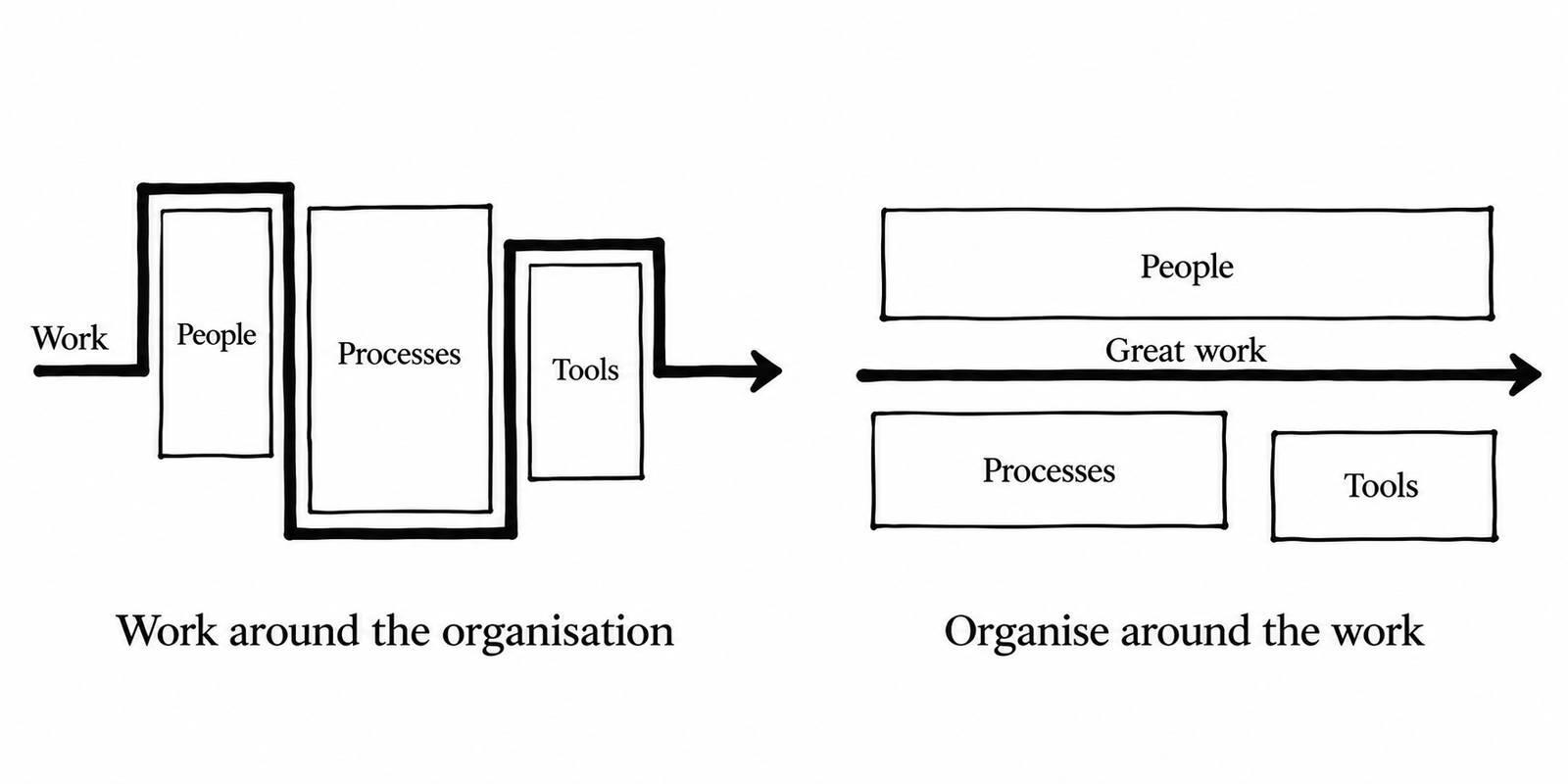
MIT’s reasoning is that AI will underdeliver at first because companies haven’t made the changes needed to take advantage of it. That happened with digital transformation too. The biggest gains didn’t come from automating existing processes. They came from redesigning them.
In my experience, that’s exactly where most organizations start in the wrong place. The first instinct is to take the process you already have and make it faster. Isn’t it curious that the first thing we ask of a technology this capable is to do the same job, quicker?
Automating the process you have usually means automating its mistakes. Most current processes carry years of workarounds and old assumptions. They’ve kept working because people in the middle quietly made judgment calls and fixed things as they went. Automate that process and you don’t get a better one. You get the same mistakes at a speed nobody can catch up with.
Who actually redesigns the process
So if the answer is redesign, who does it? Start with the people who have been making those judgment calls. They know where the process bends, and why.
Over 25 years at Lift, we’ve seen the same thing again and again. The breakthroughs happen when the organization’s own domain experts work alongside outside experts in systems thinking, design thinking, user experience, customer journey, and agentic engineering. In most organizations, neither side gets there alone. The people inside know the business in ways no outsider ever will. The people outside can see the shape of the process because they aren’t standing inside it.
There’s an important exception. The largest organizations often have internal design and systems teams that are genuinely world-class, and they can do this work themselves. Small and mid-sized businesses and nonprofits rarely have that bench. It’s an easy thing to forget, because much of what we read about AI is written from inside those very large organizations, and it quietly assumes every business has a design team down the hall. Most don’t.
This is also where I’d add to MIT’s point about expertise. They’re right that when AI is producing outputs, domain expertise is what tells you whether those outputs are any good. But if the bigger prize is redesigning the process, domain expertise has a second job: it’s one half of a collaboration. Being a great engineer, actuary, surgeon, or chef doesn’t automatically make you a systems thinker, a customer journey expert, or a user experience designer. Deep domain knowledge is essential to redesign. It just isn’t enough on its own.
The trap
There’s a catch, and it’s a costly one. Bring in the wrong outside expert and you can end up with a process that’s no better than the one you started with, or worse.
The wrong expert arrives locked into their own platform, methodology, or way of doing things. They aren’t redesigning your process. They’re installing theirs. Your business ends up bent around their stack, and you’re now automating their assumptions instead of your old ones. Nothing was redesigned for the better.
How to know you have the right outside expert
A few things to look for:
- They’re open. They aren’t locked into a particular technology, workflow, or approach for the wrong reasons. They ask whether the work could be done better if the barriers were removed.
- They start from your business. The first conversations are about how your work actually happens, not about what their product can do.
- They treat your people as half the team. Your domain experts are partners in the design, not stakeholders to be managed.
- They bring more than one discipline. Systems, design, experience, customer journey, and agentic engineering in the same room, not one handing off to the next.
- They’re willing to throw things out, including parts of the current process and parts of their own usual approach.
The same test works on the AI itself. Is it open in that same sense? Does it let you question how the work gets done, or does it lock you into its own way of doing it?
That list is also how we try to work. Our studio pages call it People and Convictions: this is what we believe, and this is how we work. Take it or leave it.
Credit to MIT Sloan for the article that prompted this (opens in a new tab). The full MIT CISR briefing is worth reading too: AI Value Creation: Five Provocative Propositions (opens in a new tab)
Written by

Micah Slavens
Principal, Lift


